Fashion, Cohort 2025
‘It’s a way to connect with them’: Dene Couture’s Tishna Marlowe on the past and future of Indigenous fashion

Sháńdíín Brown
May 1, 2026
Fashion and costume designer Tishna Marlowe credits her grandmother, Madeline, and great-grandmother, Marie Casaway (all members of Łutsël K'é Dene First Nation), for teaching her the foundations of sewing and beadwork
“My beading and my art are all about promoting my matriarchs,” Tishna explains. “Everything I do, even if they have passed on, is always about them. It’s a way to connect with them.”
Etthén Dene (People of the Caribou) was Dene Couture’s collection at the 2024 Indigenous Fashion Arts Festival (IFAF) in Toronto
“For me, my art form isn’t just about ‘Hey look at me, I’m a designer,’ it’s about preservation of culture, of my people,” says Tishna. “We are Chipewyans, Etthén Dene, people of the caribou. And we’ve been following the caribou in the harsh subarctic environment since time immemorial.


My beading and my art are all about promoting my matriarchs. Everything I do, even if they have passed on, is always about them. It’s a way to connect with them.
Tishna Marlowe
To highlight the ever-changing nature of Dene style and underscore caribou as the foundation of Dene fashion histories, Tishna constructed Theda from smoked-tanned caribou hide. The silhouette is a sleeveless hide hybrid of a sheath dress and tie-back dress with a long slip of shiny brown tulle beneath the hide. The sides and hems of the hide are ornamented with fringe, a typical element of Dene hide clothing.
For Theda, Tishna tufted the caribou chin hair as well as hand stitched the antler slices, plant seed beads, and sheefish scales and vertebrae into floral designs. When the model descended down the runway, she wore dark chocolate brown platform stilettos, matching brown satin gloves, and a tanned-hide necklace and earrings made by Tishna. It was the epitome of Dene Couture—a combination of influences ranging from the Indigenous glamazon, Madeline Marlowe and Marie Casaway’s teachings, reverence for French luxury fashion houses, and the plants as well as animals of Thaidene Nëné.
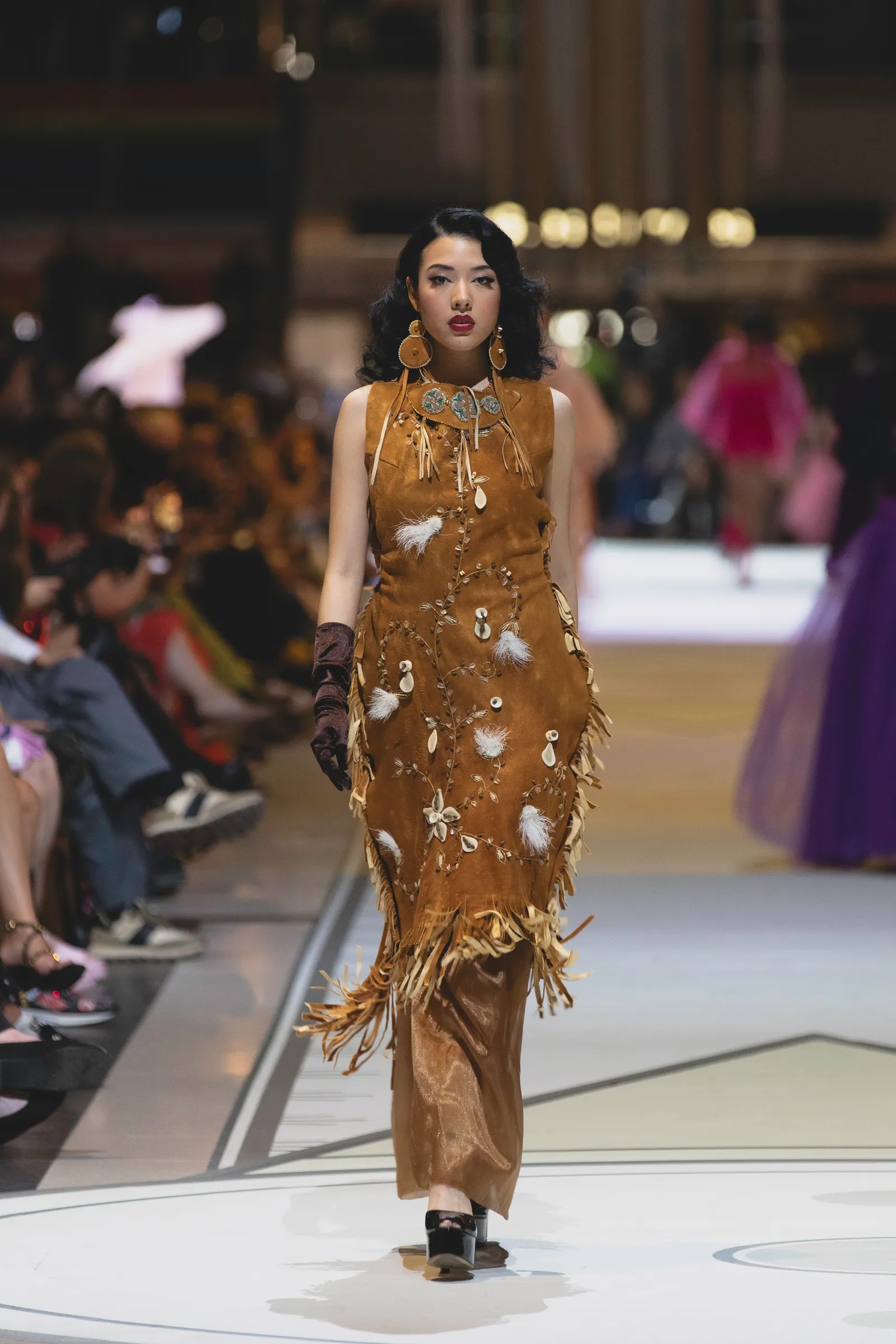
Vogue included the caribou hide gown in its coverage of IFAF: “I do the work and want to share it with the world. To be in Vogue as a Native from the sub-Arctic, with so many odds stacked up against me, I'm showing these young people from isolated communities, it doesn't matter where you're from. You can go to school, you can sew at home, you can find ways to express yourself. I feel like so many of us Indigenous people are sitting at home waiting for life to happen, but that's not how it works. You have to create your life.” Nadya Kwandibens/Red Works Photography.
Tishna is based in Calgary, Alberta, and travels back to Łutsël K'é—including driving more than one thousand miles from Calgary to Yellowknife and then a flight or boat ride—to visit family and gather or trade materials for her practice. For Theda, the material harvesting process was extremely collaborative, fostering relationality between First Nation people themselves as well as the people and the land.
Theda consists of two caribou hides. An unnamed family in Cold Lake, Alberta, hunted, harvested, and ate the caribou. Then, Victor Tssessaze (Northlands Denesuline First Nation) and his mother-in-law smoke-tanned the hides. The Dene method does not use chemicals typically used in industrial tanning. Tishna follows Dene garment histories, both pre- and post- settler contact, of constructing custom clothing, or couture clothing, from tanned hides
“Indigenous women are the backbone of Indigenous fashions,” Tishna has shared. “Each teepee and cabin is a house of couture.”
Post settler-contact, Dene makers created and continue to create garments from hides inspired by Western garment designs, ranging widely in form
Indigenous fashion scholar Shawkay Ottmann (Fishing Lake First Nation) reminds us that in Indigenous dress theory there is a constant and reciprocal spiritual transfer of energy between materials from the land and the wearer through close physical contact

Six-piece ensemble Tishna made in 2013. Photo courtesy Tishna Marlowe.
Ongoing processes of colonialism disrupted and continue to disrupt Indigenous couture-making. Tishna is keenly aware of colonialism’s impact in her community and uses couture to storytell and spread messages. Theda and its runway presentation was not a plea to return to Dene attire from the past, but a call to incorporate elements of Dene culture—including ethical subsistence hunting and sustainable animal-based fashion—into contemporary Indigenous fashion and life.
For centuries, the Canadian government’s assimilation policies have threatened Dene lifeways, including hunting caribou

Granddaughter of 1,000 Ancestors. Size 12 glass seed beads, traditional smoke-tanned moose hide, and upcycled fur. Photo by Alana Paterson.
Tishna began sewing at age five and has been making mukluks ever since
Since then, Tishna has continually built on the momentum of her success, making her own patterns, couture garments, and beaded jewelry as well as accessories. Her beadwork is a combination of her own designs, research of older Dene designs, and replications of her grandmothers’ designs. In 2015 she assembled a dress from traditional smoke-tanned moose hide with floral glass beadwork, titled Granddaughter of 1,000 Ancestors. Each floral design represents one of her family generations, referencing her matrilineal making lineage, and acknowledges moose as an important food source for Dene.
Red Dress MMIW Collection. Photo courtesy Tishna Marlowe.
Through her couture practice, Tishna brings attention to critical histories of First Nations people in Canada. She designed a red dress collection to bring attention to May 5 as the National Day of Awareness and Remembrance for Missing & Murdered Indigenous Women, Girls and Two Spirit people (MMIWG2S), also known as Red Dress Day. In a similar vein for National Day for Truth and Reconciliation or “Orange Shirt Day” on September 30 in Canada, she made an orange t-dress with archival photographs of Indigenous children from the Northwest Territories in residential schools to honor children who did not survive or were impacted by the residential school system, including members of her own family
Tishna’s refined garment construction skills, Indigenous futurism, and advocacy for Indigenous language revitalization came together in her most recent collection titled Dene Yati (Chipewyan Language). Debuted at the 2025 Vancouver Indigenous Fashion Week (VIFW), the men’s and women’s formalwear collection featured Dënesųłı̨né space-age clothing with appliqued Dene Yati in both the syllabary and alphabet. According to Tishna, the collection is based in the future, the year 3010, when she imagines that everyone has had to leave Earth and lives on spaceships. While this scenario may seem unbelievable, Tishna is drawing on histories of Łutsël K'é Dene First Nation surviving epidemics, the residential school system, and urbanization. “So how do you preserve a culture with no material culture and no land?” she asks.
The answer is language. Tishna’s first language was Dene Yati, yet she has little recollection of it and is currently relearning. “Without language you have no culture,” Tishna said. Dene Yati (Chipewyan Language) is a call for language preservation. This call starts at the local level of Łutsël K'é, to broader Dene people, and then to the global movement of Indigenous language revitalization

Tishna’s son made this Dene Yati syllabary on upcycled fabric with a fabric marker and paint. DJ Kokum (Alexis Nakota Sioux Nation) modeling. Photo Ed Photo for Vancouver Indigenous Fashion Week.
The Native fashion space has connected Tishna to other female Indigenous designers, a call back to the Dënesųłı̨né makers of Łutsël K'é. Yet, Tishna acknowledges that Indigenous fashion is much more visible now than it was when she was growing up: “We are in the midst of an Indigenous renaissance,” she says.
Amid this renaissance, how can independent Indigenous designers, like Tishna, make their work accessible to wider audiences? And with increased accessibility, how can garments be quality, long-lasting, and sustainably-made—which is especially important as Indigenous philosophies call on us to be in relation with and protect the land? For Dene Couture’s Dene Yati (Chipewyan Language) collection, Tishna utilized thrifted high-end upholstery fabrics—perhaps an urban Indigenous “hunting and gathering” technique for sustainably acquiring materials.
These questions are further complicated by the element of incorporating land-based materials, which nurture relationality and are quintessential to the energetic exchange described by Indigenous dress theory, yet can be expensive due to the required amount of time and skillset to harvest and process these materials. For example, as raw materials, traditional smoke-tanned moose and caribou hides cost thousands of dollars. And for Granddaughter of 1,000 Ancestors made from moose hide, Tishna spent 500 hours constructing the gown, which is also reflected in its price point. “It’s hard to sell clothes in an ethical way… [consumers] want a beautiful dress that is not going to cost them.” she remarked and also noted that perhaps that dress might be suited for a museum collection instead of an individual client.

Laser-cut acrylic of Dene Yati alphabet stitched to fabric. Grey material acquired from the thrift store. Photo Ed Photo for Vancouver Indigenous Fashion Week..
Looking toward the future, Tishna remains committed to making couture garments and one-of-a-kind accessories. She said, “I will always make the couture line, because that’s my language, like that is the only way I know how to express myself 100% confident.” But Tishna is also interested in ready-to-wear to expand her clientele. For Dene Couture, ready-to-wear would be Tishna’s own designs, sublimated or digitally printed on quality fabrics that she would then sew from her own patterns into standard sizes.
Continuing her grandmothers’ legacies, Tishna hopes to open a private atelier and sewing school to sell her work and teach other Native women how to make their own clothing, including garments that are emblematic of intertribal indigeneity like Pendleton coats
1
A note about tribal terminology and relationality: the Łutsël K'é Dene First Nation is a First Nations band based in the community of Łutsël K'é (Place of Small Fish), which is about a forty-five minute plane ride east of Yellowknife, Northwest Territories, Canada. The Łutsël K'é Dene First Nation is one group of Dënesųłı̨né or Chipewyan who speak Dene Yati, also called the Chipewyan language. They are a part of the broader Dene group who speak Northern Athabaskan languages. Dene traditional homelands span some of Alaska as well as parts of the Northwest Territories, Yukon, northern Alberta, northern Saskatchewan, northern Manitoba, and northern British Columbia. The broader Athabaskan language group includes: Northern Athabaskan languages, Pacific Coast Athabaskan languages, and Southern Athabaskan languages. The author of this text is Diné or Navajo and a citizen of the Navajo Nation. Diné speak Diné Bizaad, which is a Southern Athabaskan language and our traditional homelands are within the Southwestern United States. During an interview with Tishna she affectionately said “Chipewyans and Navajos are cousins.”
Sources: Chad Thompson, Athabaskan Languages and the Schools : A Handbook for Teachers. (Alaska Dept. of Education, 1984), 13-16.
“Dëne Sųłıné Resources,” Government of Northwest Territories, Government of Northwest Territories, accessed February 1, 2026, https://www.ece.gov.nt.ca/en/dene-suline.
“First Nation Profiles,” Government of Canada, Government of Canada, last modified January 14, 2026, accessed January 24, 2026, https://fnp-ppn.aadnc-aandc.gc.ca/fnp/Main/Search/FNMain.aspx?BAND_NUMBER=764&lang=eng.
Iris Catholique, “Łutsël K’é - Thaıdene Nëné National Park Reserve,” Government of Canada, Government of Canada, last modified October 20, 2024, accessed January 25, 2026, https://parks.canada.ca/pn-np/nt/thaidene-nene/activ/culturelle-cultural/lutsel-ke.
Michael I. Asch, “Dene,” The Canadian Encyclopedia, The Canadian Encyclopedia, May 15, 2017, accessed January 24, 2026, https://thecanadianencyclopedia.ca/en/article/dene.
Tishna Marlowe, “Forging Interview with Tishna Marlowe,” interview by Sháńdíín Brown, November 12, 2025, Facebook Messenger Audio Call, 1:08:06.
⏎2
There are various spellings of Etthén, including Etthën and Ethen.
⏎3
The Dënesųłı̨né were historically nomadic and for much of the year followed migratory herds of caribou based off seasonal cycles. Other times of the year, they settled seasonally. Beginning around the early 18th century factors such as the fur trade and eventually Canadian government assimilation policies like the residential school system and forced relocation, natural resource-based industries, and the introduction of modern technology led Dënesųłı̨né to live in singular communities year-round.
Sources: Athabasca Chipewyan First Nation et al., Remembering Our Relations: Dënesųłıné Oral Histories of Wood Buffalo National Park (University of Calgary Press, 2023), xix, 14, 17-19, 30, 38-40, 43, 48, 56, 63, 83, 204, 215, 217, https://doi.org/10.2307/jj.9891547.
Patricia A. McCormack and James G. E. Smith, “Denesuline (Chipewyan),” The Canadian Encyclopedia, The Canadian Encyclopedia, February 6, 2006, accessed January 17, 2026, https://thecanadianencyclopedia.ca/en/article/chipewyan.
⏎4
Dënesųłiné contact with Europeans began in the 17th century though trade and formal treaty relations with the Canadian government were established beginning in the late 19th century.
Sources: Patricia A. McCormack and James G. E. Smith, “Denesuline (Chipewyan),” The Canadian Encyclopedia, The Canadian Encyclopedia, February 6, 2006, accessed January 17, 2026, https://thecanadianencyclopedia.ca/en/article/chipewyan.
John Collin Yerbury, The Subarctic Indians and the Fur Trade, 1680-1860 (University of British Columbia Press, 1986), 17-22.
⏎5
Some examples include this early 20th century military-style women’s dress and this replica of a men’s barn coat originally made in 1970.
⏎6
The caribou chin hair was harvested by Tishna’s uncle Fred Marlowe. The caribou antlers were from Tishna’s uncle Mod Casaway, Fred Marlowe, James Marlowe, Raymond Marlowe, and Iris Catholique. The sheefish was from Mary Rose Casaway, Marcy Casaway, Raymond Marlowe, Arlene Whiteduck, Larry Catholique, Troy Johnny Dzentu, and Roger Catholique (all members of Łutsël K'é Dene First Nation) in Łutsël K'é. After trading cigarettes for the sheefish, Tishna harvested the vertebrae and scales from the fish. Additionally, she harvested the seed beads in Calgary with Karen Wright-Fraser (Gwichʼin) who taught her how to harvest and prepare them.
⏎7
Shawkay Ottmann. “Indigenous Dress Theory in Canadian Residential Schools.” Fashion Studies 3, no. 1 (2020): 7, https://doi.org/10.38055/FS030105.
⏎8
Ibid.
⏎9
Michael I. Asch, “Dene,” The Canadian Encyclopedia, The Canadian Encyclopedia, May 15, 2017, https://thecanadianencyclopedia.ca/en/article/dene.
⏎10
11
Mukluks are soft-soled animal-hide boots worn by Indigenous people of the Arctic and subarctic areas.
⏎12
Moss bags are First Nations padded pouches to hold infants and lace the child inside the pouch. Another type of First Nation/Native American baby carrier is a strap or beaded belt.
⏎13
In the context of the fur trade, a trapline is the path that trappers set traps for fur-bearing animals. Beyond fur, the meat from these animals also provides sustenance for families and communities.
⏎14
A t-dress is a specific Native American/First Nations loose-fitting silhouette, sometimes called a tradecloth dress.
⏎15
The production of the collection was collaborative. Tishna’s language consultants were Bertha Catholique (Łutsël K'é Dene First Nation) and Catherine Boucher (Dene). She received technical support from Tyler Jordan and Natalia Bermeo (Cañari community of Azogue). Tishna created the collection during her 2025 Banff Centre for the Arts and Creativity Fleck Fellowship.
⏎16
Pendleton coats are coats made from Pendleton Woolen Mills blankets with Native tribal patterns and designs.
⏎See Also
Governance, Q&A
‘Our way of life doesn't mean anything to them’: A Q&A on cultural resistance in Gayogo̱hó:nǫ’ Nation

Cohort 2025, Conversation
‘Botany of Empire’: A conversation on the study of plant life
